
These are my cast iron skillets. I adore them. I won’t make pineapple upside down cake or cornbread in anything else. My great grandmother bought them; she used them, my grandmother used them, my mother used them, and now I use them. They are seriously seasoned. And they survive and look fabulous to this day because I follow, as taught to me by all those women before me, The Rule of Cast Iron: Soap is the enemy. Look, it just IS. You just cannot convince me it’s okay to use soap on a cast iron skillet. It’s not. I once nearly fired a maid service because they used SOAP to clean a skillet. I wanted to cry.
So here’s what I do: after frying up bacon (saving the grease for green beans and cornbread, obviously), sausage, pancakes, whatever, I get to work cleaning the pan. It’s easiest to do this while the pan is still warm, so hop to it. For most situations, I do a quick rinse under HOT running water. If there’s anything really stuck, I use a stiff brush that I keep just for the purpose of cast iron and scrub stuck-on bits off under HOT running water. Then I set the pan back on the warm burner on the stove and leave it on till all the water evaporates (rust is not your friend). When it’s completely dry, put a little oil in the pan — olive oil, shortening, whatever — and briskly rub it around with a paper towel till all surfaces are covered. The end. I keep mine stored in a stack with paper towels in between them to absorb any errant moisture in the air (again, that rust thing).
And that’s it. Seriously. It’s not hard, but there is a method to it. And the method does not, ever, not even once, involve soap.
/lecture
What to do if your cast iron is a little less than kitchen-ready?
Start by removing any possible rust. Pour some salt on the pan (kosher is great) and cut a potato in half. Use the potato like a brush and scrub the salt around to loosen everything up.
Then scrub it under super hot water with a stiff brush (not wire — like a stiff dish scrubbing brush), and set it on a burner on low-medium to dry completely.
Now the stinky part: re-seasoning! Cover the bottom rack of your oven with foil — it’ll make any drips easier to clean up. Now melt about a Tbsp or so of Crisco in the cast iron on the stove top. Use a paper towel to wipe the melted crisco over ALL surfaces of the pan — the handle, the top, the bottom, the edge, etc. Everywhere.
Put it upside down in the oven, and turn the oven on to 350. Bake for at least an hour, then turn the oven off, but leave the pan in there till it’s cool. And voila! I bet you have a pretty spiffy looking pan at the end.
 Square bready goodness.
 And it came out great! The Kiddo loves it (that’s huge) for cinnamon toast in the morning, and Sunbutter sandwiches for “wunch.”


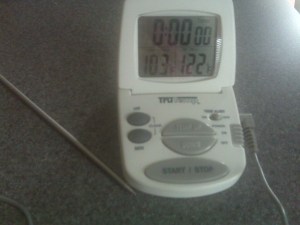 That is my thermometer registering 103 degrees. Please to notice the probe is sitting on the counter. This. Is. Not. Good. After a lot of quality time with Google, I came to the conclusion that the likely problem was water in the probe; completely immersing the probe in water to wash it gets water in places it’s not meant to be. The solutions suggested were either boiling the probe in peanut oil for half an hour, or baking it in the oven at 300 degrees for half an hour, either of which should theoretically evaporate any water in the probe and render it useful again. The oven appearing to be the safest, least smoky option, I baked it. Slapped it right on the rack in the toaster oven at 300 degrees and let it cook for about half an hour. Voila, problem solved!
 One Particular Kitchen